
Why this topic matters
Long-term investing is less about never selling and more about refusing to abandon a sound process. Investors who skip structure end up reacting to price alone.
This guide gives you a durable framework you can reuse across tickers and market regimes, then points you to live tools inside Vest Terminal and deeper metric lessons in Learn.
Core concepts
Time Horizon
Treat time horizon as a decision input, not a slogan. Define the metric or rule in plain language, note what would falsify it, and record the source you will monitor.
When time horizon looks attractive in isolation, cross-check related statements, peer context, and filings so you are not optimizing a single number.
Practically, keep a short note template: definition, current reading, peer range, and the action you will take if time horizon deteriorates for two reporting periods.
Noise Vs Signal
Treat noise vs signal as a decision input, not a slogan. Define the metric or rule in plain language, note what would falsify it, and record the source you will monitor.
When noise vs signal looks attractive in isolation, cross-check related statements, peer context, and filings so you are not optimizing a single number.
Practically, keep a short note template: definition, current reading, peer range, and the action you will take if noise vs signal deteriorates for two reporting periods.
Checklist Discipline
Treat checklist discipline as a decision input, not a slogan. Define the metric or rule in plain language, note what would falsify it, and record the source you will monitor.
When checklist discipline looks attractive in isolation, cross-check related statements, peer context, and filings so you are not optimizing a single number.
Practically, keep a short note template: definition, current reading, peer range, and the action you will take if checklist discipline deteriorates for two reporting periods.
When To Change Mind
Treat when to change mind as a decision input, not a slogan. Define the metric or rule in plain language, note what would falsify it, and record the source you will monitor.
When when to change mind looks attractive in isolation, cross-check related statements, peer context, and filings so you are not optimizing a single number.
Practically, keep a short note template: definition, current reading, peer range, and the action you will take if when to change mind deteriorates for two reporting periods.
Worked reasoning with a familiar large cap
Take a widely followed name such as GOOGL or AAPL. Pull the company profile, multi-year financials, and valuation multiples side by side.
Ask whether the narrative you hold matches the last three years of revenue, margins, and cash generation. If it does not, update the narrative — do not invent reasons to keep it.
Then place valuation in sector context. Absolute cheapness without peer comparison is how value traps recruit new capital.
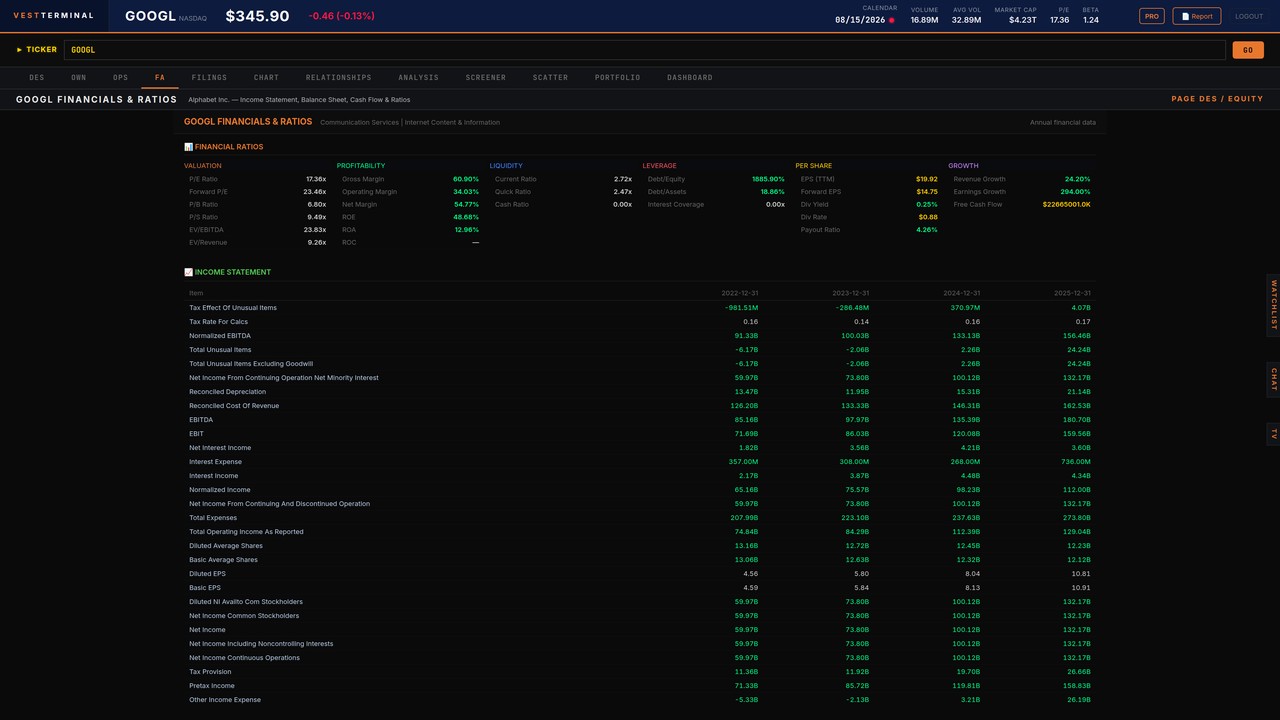
Apply this framework on a live ticker in Vest Terminal.
Start FreeProcess checklist
- Write the investment question in one sentence
- Gather business, financial, and valuation evidence
- List three risks that would invalidate the idea
- Decide position size before entry
- Schedule a review date — do not rely on memory
How Vest Terminal supports this workflow
Use DES for business orientation, FA for statements and ratios, filings for primary disclosure, charts for regime context, and portfolio tools to track outcomes.
Education pages such as the linked Learn guides keep definitions consistent so your notes stay comparable over time.
Mistakes to avoid
- Confusing a good company with a good investment at today’s price
- Changing rules after every green or red day
- Ignoring cash flow when earnings look smooth
- Skipping filings because a summary felt sufficient
Putting it all together
Skill in markets compounds when your process is written, repeated, and reviewed. The goal is not perfect forecasts; it is fewer unforced errors.
Return to this article when you feel pulled into improvisation. Then open the terminal, run the checklist, and let evidence — not urgency — decide.
For adjacent reading, browse the category archive and the platform guides if you are still choosing tools.
Continue in Vest Terminal — research with a checklist, not a hunch.
Start FreeAdvanced angles on The Long-Term Investing Mindset
As you go deeper on the long-term investing mindset, distinguish leading indicators from lagging confirmations. Leading indicators help you prepare; lagging confirmations help you avoid self-deception after the fact.
Create a one-page scorecard unique to this topic with no more than eight fields. If a field never changes a decision, delete it. Scorecards exist to force trade-offs, not to decorate research folders.
Share the scorecard with a skeptical peer or future-you note. The act of explaining the long-term investing mindset out loud usually reveals hidden assumptions faster than another hour of silent browsing.
Translate qualitative claims into observable metrics whenever possible. “Strong moat” should map to retention, margins, or reinvestment returns; “cheap” should map to a multiple versus history and peers.
Build a small library of prior examples — both successes and failures — tagged by the failure mode. Pattern recognition across your own history is more valuable than collecting more unused frameworks.
Deeper implementation notes
After you understand the core framework, implementation quality determines outcomes. Write down the exact data sources you trust, the cadence of reviews, and the personal rules that prevent impulsive overrides when headlines spike.
Keep a short research journal for every active idea: date opened, thesis in three bullets, key metrics to watch, valuation paid, and the conditions that would force an exit or a trim. Journals turn vague conviction into auditable process.
When metrics conflict, prioritize cash generation and balance-sheet resilience over elegant narratives. Markets eventually reconcile stories with free cash flow, funding needs, and competitive reality.
Connecting research to portfolio construction
A researched idea still needs sizing. Cap single-name risk, consider correlation with what you already own, and avoid letting a high-conviction story become an accidental concentrated bet.
Use watchlists as a staging area. Not every researched ticker deserves capital today. Staging reduces FOMO buys and creates a ready pipeline when prices or setups improve.
Revisit winners and losers with the same checklist. Process reviews beat outcome celebrations — a profitable mistake can still teach the wrong lesson if you never inspect how the decision was made.
Using Vest Terminal without drowning in tabs
A practical session structure helps: screen or watchlist first, DES for business orientation, FA for multi-year numbers, filings for surprises, ownership for incentive context, then chart for timing. Close with a written decision.
Link education as you go. If a multiple or margin confuses you, open the matching Learn guide, then return to the live ticker. Definitions that stay consistent across notes make historical comparisons meaningful.
On paid plans, saved screens, broader limits, and collaboration features reduce friction for teams. Start with the free workflow until the bottleneck is clearly product limits rather than personal process gaps.
Risk, uncertainty, and intellectual honesty
Every framework fails in some regimes. Name those regimes in advance. If your approach assumes stable margins, ask what industry shock would break them. If it assumes mean reversion, ask what structural change would prevent it.
Prefer base rates and peer evidence over single anecdotes. One spectacular success story is marketing; a distribution of outcomes across similar businesses is research.
Finally, separate forecasting from positioning. You can be uncertain about precise outcomes and still take a modest, well-risked position when asymmetric payoff and process quality line up.
Action plan for the next seven days
Day 1–2: pick one workflow from this article and run it on two familiar large caps. Day 3–4: document what felt unclear and fill those gaps with Learn guides. Day 5: build or refine one screener or watchlist rule set. Day 6–7: review notes and delete steps you did not actually use.
Compression beats collection. A shorter checklist you execute weekly outperforms a perfect checklist you abandon. Revisit this article monthly until the steps are muscle memory.
When you are ready to operationalize, keep Vest Terminal open beside your notes so evidence gathering and decision writing happen in one sitting rather than across a week of forgotten tabs.